
There is always a touch, secret and great!
There is always a feeling, endless!
Yesterday, alumni donated 78 million anonymously.
Brushed the circle of friends of Wu Daren.
The topic quickly rushed to the hot search.
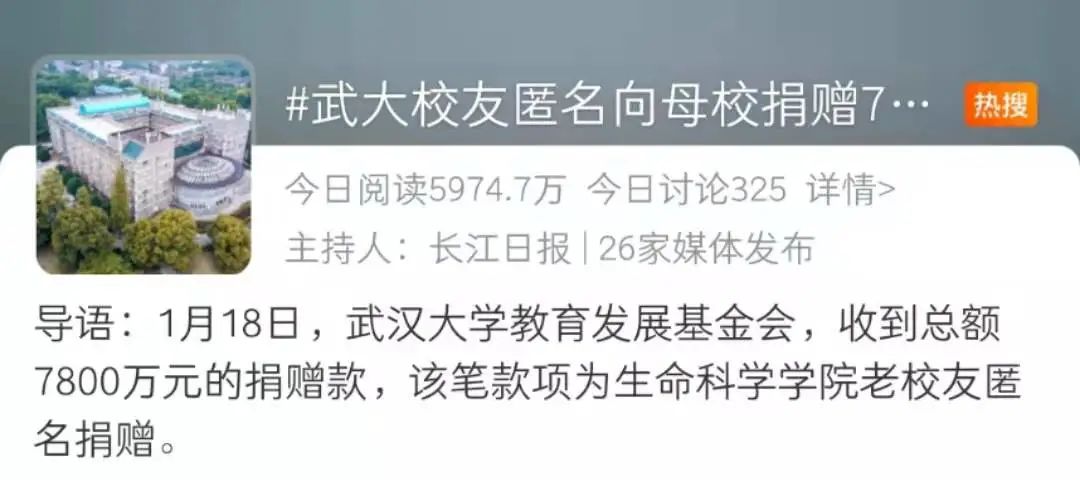
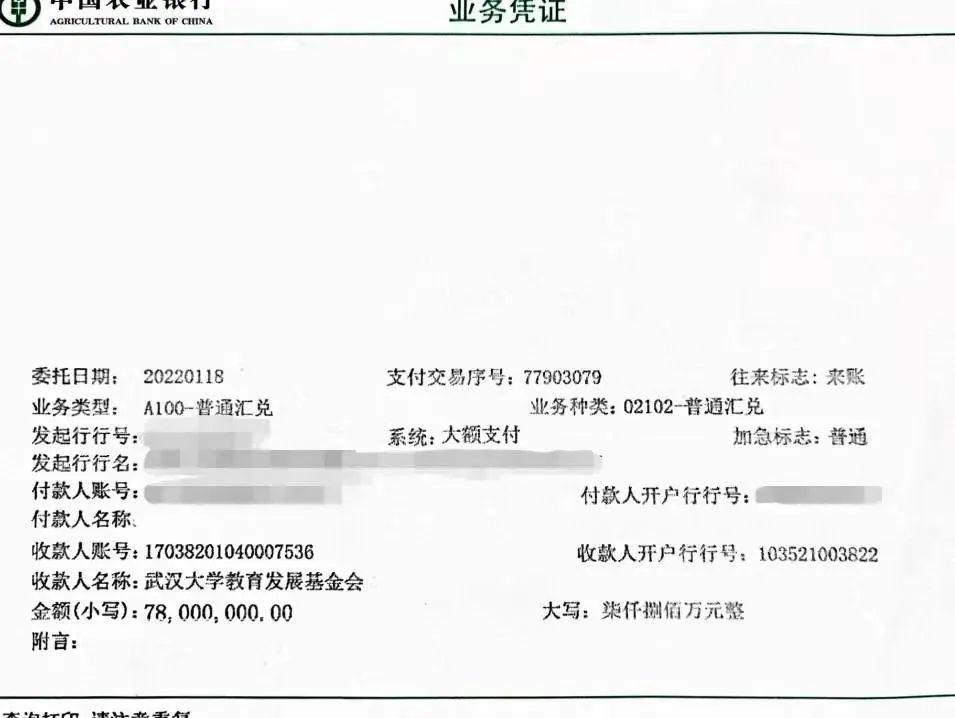
This 78 million donation comes from
An anonymous alumnus from School of Life Sciences, Wuhan University
Out of gratitude for the care and training of Wuhan University.
Decided to turn their scientific and technological achievements into income.
Donate anonymously to your alma mater.
At the same time, in the name of teacher Yu Xianjue,
Name the donation project as
"Yu Xianjue Life Science Education Fund"
Who is Mr. Yu Xianjue?
Why is the 78 million donation named after him?
With Luo Luo Jia Jia
Find the answer to the story.
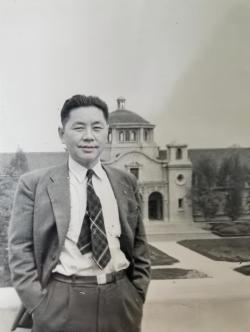
Yu Xianjue, Professor of School of Life Sciences, Wuhan University. People from Changsha, Hunan. Graduated from biology department of Wuhan University in 1935. In 1949, he received a doctorate in philosophy from California Institute of Technology. After returning to China, he served as a professor at Wuhan University, director of the Department of Genetics of the Department of Biology, and the first and second directors of the Hubei Genetic Society. Member of China Democratic League. Since 1980, the karyotype of freshwater fish has been studied and achieved results. Editor-in-chief of Genetics, and author of papers such as Studies on Chromosomes of Freshwater Fish in China.
//
In November 1909, Yu Xianjue was born in a peasant family in Changsha County, Hunan Province. My parents make a living by farming and have eight children, and Yu Xianjue ranks third. Because of his poor family, his parents had to adopt one of his brothers to his uncle who was in business. And my brother provided him with a lot of financial assistance for his later schooling. Yu Xianjue grew up in such a typical southern rural family, studied hard, made progress and was strong since childhood, and had a strong love for nature and biology.
In 1931, he was admitted to the Biology Department of National Wuhan University with honors. During his college years, he not only got excellent grades, but also loved sports. When he graduated in 1935, he was recommended by Professor Zhang Yingwu, an embryologist, to stay in school as a teaching assistant in the Department of Biology.
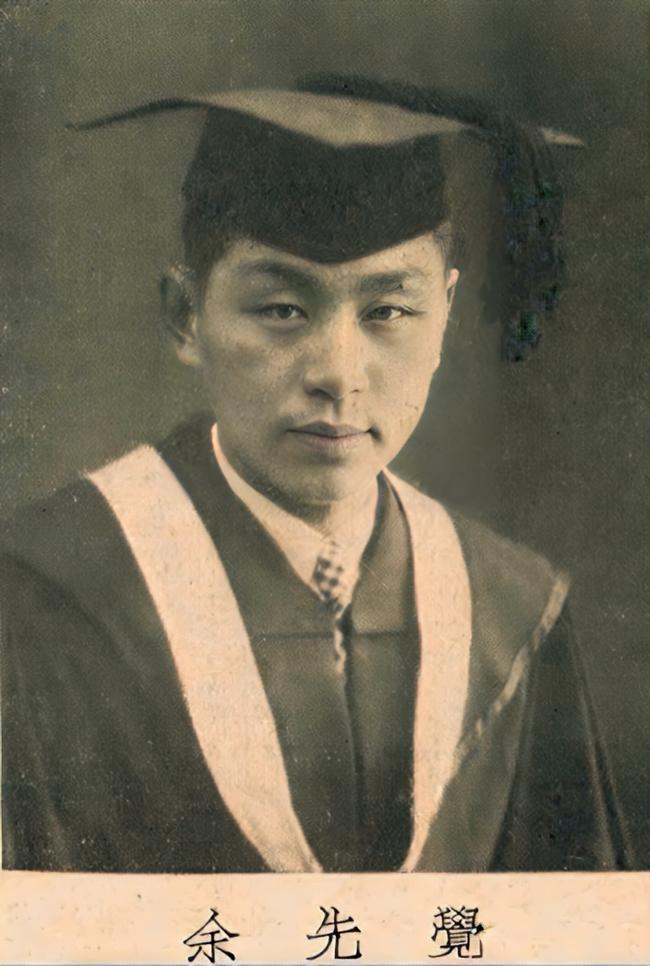
▲ Yu Xianjue graduation photo, a bachelor of Wuhan University in 1935.
Ten years after his graduation, during the period of War of Resistance against Japanese Aggression, he moved to Leshan, Sichuan with Wuhan University. During the hard war years, he not only didn’t lose his major, but also studied hard, worked hard, compiled his own handouts, and enriched his theoretical knowledge in the teaching practice of histology, cytology and embryology. In the second year after the victory of the Anti-Japanese War, Yu Xianjue was funded by the Lee Foundation and was sent to the Biology Department of California Institute of Technology to study for a doctorate. Yu Xianjue entered Morgan’s laboratory at California Institute of Technology and became a student of Professor Sturtevant.
Mendel made a pioneering contribution to establishing the basic principles of genetics. Morgan and his students used Drosophila as materials to discover the laws of sex-linked inheritance, linkage, exchange and non-segregation, and put forward the theory of genes, which is a significant development of Mendel’s theory of genetics and laid the foundation for the development of modern genetics. Professor Yu Xianjue is a modern geneticist who grew up in Morgan’s laboratory during this period.
At that time, Morgan, the founder of the biology department of the school, had just passed away, and Morgan’s eldest disciples, Sturtevant and Mrs. Morgan, continued to study fruit flies in Morgan’s laboratory. Sturtevant received his doctorate from the Drosophila Laboratory in Morgan, Columbia University in 1910, and then came to California Institute of Technology with Morgan. Sturtevant students E. B. Lewis and E. Novitski gave Yu Xianjue direct guidance in experimental research. Lewis later became an academician of the American Academy of Sciences, and won the Nobel Prize in 1995 for his achievements in developmental biology of Drosophila.
Four China scientists of the older generation have studied in this laboratory, namely Li Ruqi, Tan Jiazhen, Lu Huilin and Yu Xianjue. Yu Xianjue completed his research work during his doctoral period in 1949, wrote a 112-page doctoral thesis, successfully passed the doctoral thesis defense, and obtained his doctorate.
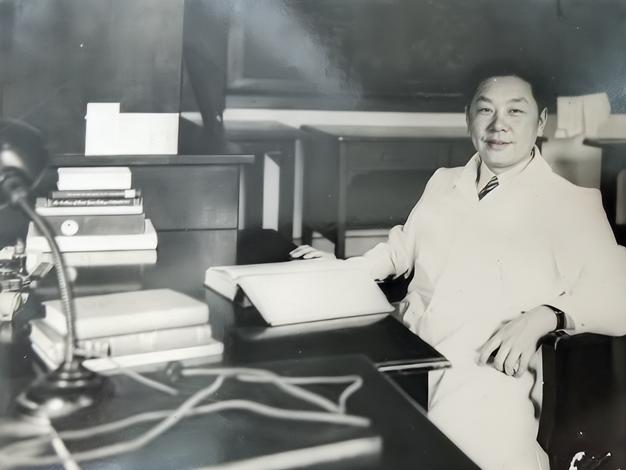
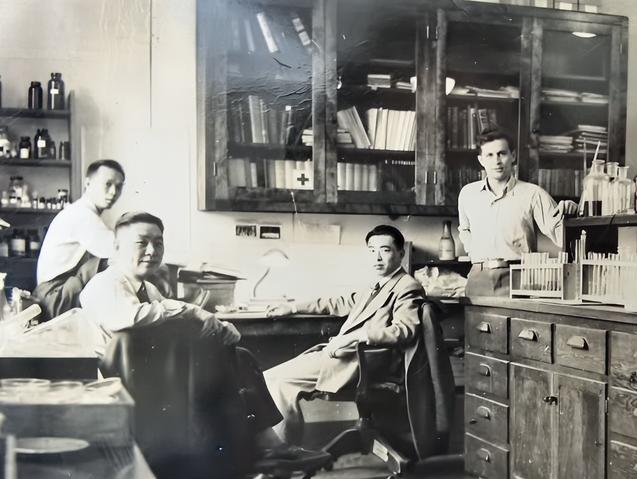
▲ Yu Xianjue at California Institute of Technology, USA
Yu Xianjue’s doctoral thesis is to study the reverse mutation and position effect of Drosophila by X- ray technology, and his tutor and Lewis are very satisfied with his experimental results. Yu Xianjue made a series of new discoveries, including the famous antenna foot mutation in modern genetics textbooks. This Drosophila mutant named AntpYu was recommended by Lewis and incorporated into the genetic variations of Drosophila melanogaster, and published by Carnegie Institute in 1968. The discovery of this mutant laid a foundation for Lewis and others to study homeobox genes and the development of Drosophila. Also included in the book is T (2; 3)AntpYu mutation, B48g, Scar, T (2; 3)B48g and t (2; 3) Scar mutation, etc.
Yu Xianjue is very patriotic. After receiving his doctor’s degree, he decided to go back to China and devote himself to the construction of new China. At that time, his brother was the Consul General of the National Government in Houston, and repeatedly advised him to stay in the United States, but Yu Xianjue’s determination to return to China never wavered. The journey to "go home" was hard. He knew that the motherland lacked professional books, and brought back a large number of professional books and documents with him. When he returned to Tianjin to go ashore, it coincided with the establishment of New China on October 1, 1949. After several rounds of rolling, he returned to Wuhan and once again devoted himself to Luojiashan as a professor in the Department of Biology of Wuhan University. Yu Xianjue has taught in the Biology Department of Wuhan University for more than 50 years.
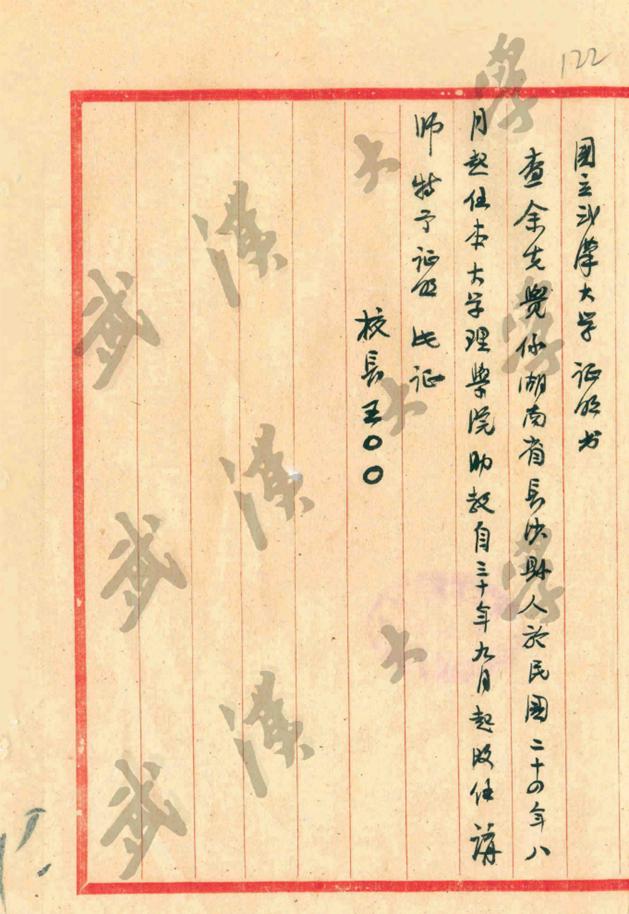
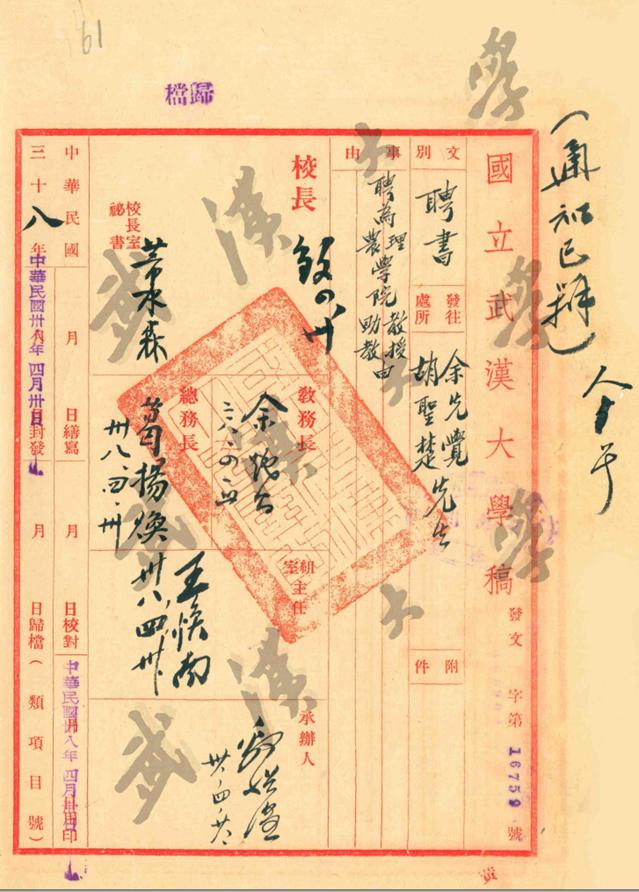
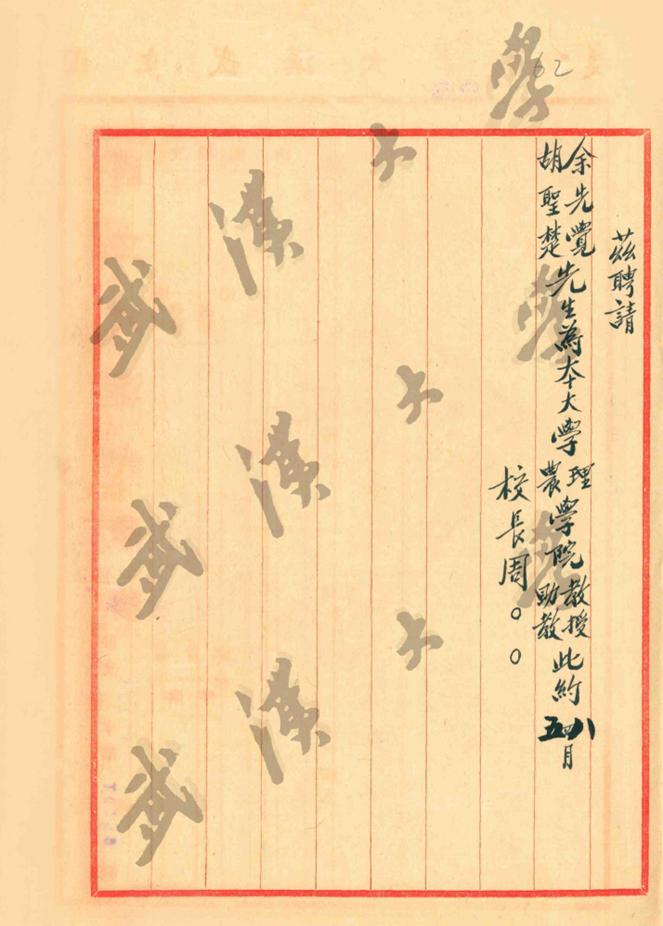
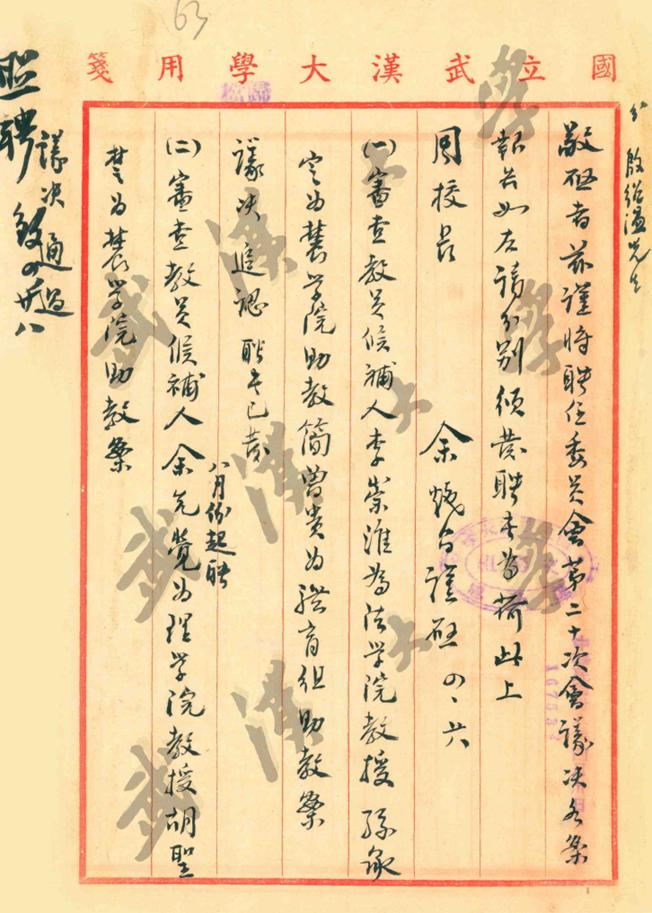
▲ In 1941, a certificate proving Yu Xianjue’s service time at school,
Wang Xinggong’s signature (top left). The other three are about the employment of Yu Xianjue in 1949.
Letter from Hu Shengchu as a Professor of Science College
Yu Xianjue is a loyal Morgan scholar. Since the 1960s, with the acceptance of Morgan School in the whole country, he selected fish as materials for genetic experiments and enrolled graduate students. However, it was soon devastated by another decade, and the newly established genetics laboratory had to be terminated. It was not until the end of the Cultural Revolution in 1978 that he resumed recruiting graduate students and conducting genetic research.
The Chinese Genetic Society was established in 1979, and Professor Yu Xianjue was elected as the first director of the Chinese Genetic Society and the first editorial board of the Journal of Genetics. In the same year, Yu Xianjue advocated the establishment of Hubei Genetic Society, and served as the chairman of the Society for four consecutive years, making great contributions to the development of genetics in Hubei Province. In 1980, he was elected as the first director of China Society of Cell Biology. After the National Science Conference in 1978, he compiled the outline of "Introduction to Genetic Engineering" and made a report to Hubei provincial authorities, Wuhan University and other universities, which played an important role in publicizing Mendel’s genetic theory and popularizing genetic knowledge.
He and graduate students have conducted extensive research on cytogenetics of freshwater fishes in China, and obtained the first-hand information on cytogenetics of freshwater fishes in China, which is the first systematic study on chromosomes of freshwater fishes in China in China. The research achievement "Study on the Karyotype of Freshwater Fish in China" won the second prize of the Science and Technology Progress Award of the State Education Commission in 1988, and was edited by Yu Xianjue and published in Science Press in 1989. This book has become a reference book in the field of fish genetics research.
On the basis of these studies, he further studied the fine structure and genome of fish chromosomes, and the research result "Study on the Fine Structure and Genome Structure of Fish Chromosomes" won the second prize of the Science and Technology Progress Award of the State Education Commission in 1995.
Yu Xianjue’s granddaughter Yu Li said that Grandpa’s students have always been in contact with their families, and this anonymous donation by alumni was also directly contacted with her. She felt very surprised and very moved. "My mother and I have advised before, but the alumni said that this is their long-cherished wish for many years."
Following Yu Xianjue’s footsteps, Yu Li has also been teaching in the College of Life Sciences. She grew up beside her grandfather. At that time, she didn’t know much about her grandfather’s work. She just felt that other people’s grandfathers seemed to have time to play with their grandchildren every day, but her grandfather was very busy all day long. Occasionally, she would take her to make gecko specimens or climb Luojia Mountain to plant small plants when she was free. I didn’t understand until I grew up. Influenced by the Cultural Revolution, Grandpa, as a modern geneticist who grew up in Morgan’s laboratory, had interrupted his academic research countless times, so once he returned to his scientific research post, he devoted himself to his work with double enthusiasm and energy.
In her memory, there were always students coming and going at home, some came to ask grandpa academic questions, some came to report the progress of the experiment, and grandpa was always cheerful and equal and gentle to the students. If he was still talking about work at dinner time, he would ask his mother to serve a bowl of noodles covered with eggs and continue to discuss the problems with the students while entertaining. At that time, a bowl of egg noodles could be said to be quite good food.
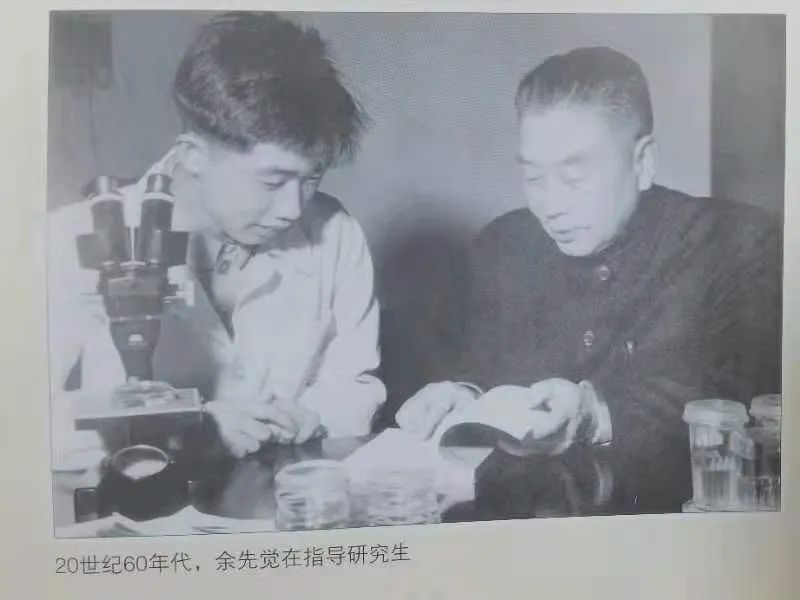
▲ In the 1960s, Yu Xianjue was instructing graduate students.
Yu Xianjue was honest and broad-minded all his life. Peace of mind and noble character; Life is simple, honest and simple; Strict scholarship and profound knowledge; Good teaching and tireless teaching. He has successively directed cytology experiments and embryology experiments, and taught courses such as histology, cytology, genetics, zoology, entomology, introduction to biology, agriculture and livestock breeding and cytogenetics.
His teaching preparation is well-prepared, his lecture language is accurate, his concept is clear and his logic is strong. He always said, "If you don’t memorize in advance and think about what to say temporarily, it’s easy to digress and make mistakes." His teaching has been well received by teachers and students in the Department of Biology.
Yu Xianjue attached great importance to discipline construction and personnel training, and established the doctoral program of genetics in Wuhan University, which was also the second batch of doctoral programs in China at that time. Now it is a national key discipline and a comprehensive genetic research institution and personnel training base with complete research directions in plant genetics, animal and human genetics and microbial genetics. Professor Zhu Yingguo, an academician of China Academy of Engineering, and professors Yu Qixing, Song Yunchun, Zhou Gang, He Guangcun, Yang Daichang, Hu Zhongli, Li Lijia and Li Yangsheng all grew up in this doctoral program. In his later years, he enrolled the only postdoctoral fellow, Zhou Rongjia, and later became a professor in the department.
"This alumnus who donated anonymously is my senior. I am also very excited to hear about this charity. He is definitely influenced by Teacher Yu. This is a typical student of Teacher Yu!" Zhou Rongjia said. In 1992, Zhou Rongjia entered Wuhan University to engage in postdoctoral research with Yu Xianjue. At that time, Yu Xianjue, who was over 80 years old, was in poor health, but he still talked with Zhou Rongjia specifically and told him to be a good person before doing scientific research.
"This sentence has a great influence on me," Zhou Rongjia remembers vividly. At that time, the conditions of the postdoctoral mobile station were very difficult, and many studies were almost started from scratch. Yu Xianjue gave Zhou Rongjia great autonomy and allowed him to play freely within the framework of fish genetics. "The old man was very low-key, but he did very well academically. He said that being a man must have a pioneering spirit, which has had a profound impact on my academic path. "
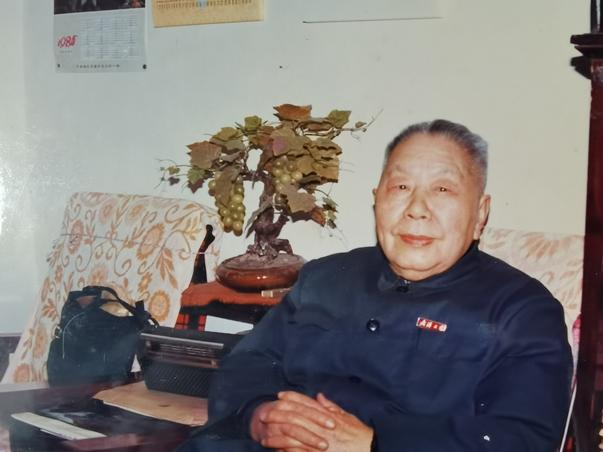
▲ Mr. Yu Xianjue’s later years
On August 10, 1994, Yu Xianjue passed away at the age of 85. Dear teacher Yu, students will always remember you!

In 2021, Wuhan University
Alumni’s newly signed donation exceeded 1.5 billion yuan.
Accumulated alumni donations of 3.043 billion yuan.
Ranked third in the country (click to view ↑)
Drinking water from the source, from generation to generation.
Be grateful and hide your fame.
On the way forward,
Yong is a teenager in Luojia.
—RECOMMEND—
Recommended reading
Arrive at the account! Wu Da alumni donated 78 million anonymously.
Original title: "For him, students donate 78 million anonymously! 》

关于作者