月度归档 2026年1月6日

通过admin

The popular science education for young people has been solidly promoted.

  In recent years, all localities have solidly promoted popular science education, promoted popular science resources to enter primary and secondary schools, encouraged students to enter off-campus popular science bases, and improved the evaluation and guidance of popular science education effects, so that the majority of young people can approach science and fall in love with science. The National Science Popularization Day in 2023 was held in various places from September 17th to September 23rd. In this edition of education, let’s focus on the active exploration in developing popular science education and improving young people’s scientific quality in several places.

-editor

  Professionals act as the main force of popular science

  [lens]

  "Students, what do you think the painter Leonardo da Vinci and the surgical robot Leonardo da Vinci have in common?" "They are all creators, but their fields are different." Peng Yaqin, a graduate student at the Institute of Automation, China Academy of Sciences, was pleasantly surprised by the philosophical and childlike answers given by primary school students in the popular science class at Taishitun Town Central Primary School in Miyun District. On the podium, Peng Yaqin explained the application of artificial intelligence in surgical medicine in a simple way. Under the podium, the students listened with relish and interacted with the teacher in real time.

  In the "Vernal Equinox Project" youth science popularization special action of the University of Chinese Academy of Sciences, such scenes happen from time to time. "What kind of science and technology feast will volunteer brothers and sisters bring this week?" The weekly popular science class has become the expectation of small science and technology fans in more than 30 primary and secondary schools in Miyun, Huairou and other districts of Beijing.

  "In 2018, on the occasion of the 40th anniversary of the founding of the University of Chinese Academy of Sciences, the school launched the’ Vernal Equinox Project’ youth science popularization special action. Relying on the strength of teachers and students of the Science and Education Integration College of the National Science and Technology University, we are committed to improving the scientific literacy of young people in the form of popular science reports, scientific and technological counseling, and public welfare education. " Liu Weiqiang, Minister of Propaganda Department of the Party Committee of National Science and Technology University, introduced.

  Why are there so many pits on the moon? How do bees make honey? How to make the chip … Only last semester, the graduate students of the National Science and Technology University of China gave more than 1,800 interesting and informative popular science reports, which conveyed the happiness of scientific creation to young people and made the buds of science grow sturdily in their hearts.

  "Students, knowing yourself is an important topic in life." Yu Wanrong, a graduate student from the Institute of Psychology, Chinese Academy of Sciences, gave a popular psychological science report to the students of the Sixth Primary School in Huairou District, Beijing. From theory to experiment, clever introduction and patient explanation, the 45-minute course taught students how to treat psychology scientifically and their emotional changes.

  Through the help of graduate students in primary and secondary schools, the teachers of Huairou Sixth Primary School are full of praise for this way. In their view, the "vernal equinox project" has nurtured the scientific seeds in children’s hearts like spring breeze and rain.

  "There are more than 100 teachers behind the many courses of the Vernal Equinox Project to provide guidance for graduate students who participate in popular science, and strive to bring students the best experience and harvest in each class. Behind this, more than 100 teachers from the National Science and Technology University are quietly paying. " Wu Baojun, executive deputy secretary-general of the National Science and Technology Association, introduced.

  "The’ Vernal Equinox Project’ not only serves the science education in primary and secondary schools, but also helps to cultivate the social responsibility and responsibility of the students of the National Science and Technology University." Wang Yanfen, executive deputy secretary of the Party Committee of the National Science and Technology University, expressed the hope that the students of the National Science and Technology University will realize the personality temperament and value pursuit of "erudition and dedication" and achieve all-round development in the practice of serving the society.

  Innovative activities enrich popular science carriers.

  [lens]

  In front of the exhibition board of "Beautiful Days and Beautiful Elephants" weather station in Qibao Zhenming Qiang Primary School, Minhang District, Shanghai, students are concentrating on changing today’s weather information. "This week’s weather forecast is at the forefront", "Daily dressing suggestions are posted here" and "You don’t have to worry about getting wet with rain gear reminders" … This is the epitome of the project-based learning course of "Tips for Self-made Meteorological Life" in Mingqiang Primary School. Students collect, record and sort out weather information under the guidance of teachers, make judgments based on life experience, and apply meteorological knowledge to daily life.

  Since 2020, Mingqiang Primary School has vigorously carried out meteorological science popularization activities, and the east and west campuses have successively established campus meteorological stations and smart learning spaces. With the support of the professional meteorological department, the school has developed a series of scientific practice activities suitable for students of different grades. "We hope that students can feel the wonder of meteorological science in the experience activities of interesting needs, learn to study independently and carry out innovative practice." Liu Yiting, vice president of Mingqiang Primary School, introduced.

  "How is the wind formed and what are its characteristics? How to prevent it when encountering windy weather? " Open the picture book "Meteorologist" compiled by our school, and explain the formation principle of common weather phenomena such as rain, clouds, snow and fog in easy-to-understand language, which is skillfully integrated with different fields such as art, literature and science, making the meteorological class more lively and interesting.

  "With VR glasses on, we can appreciate the climate of the four seasons in the teacher’s digital courseware, and we can also do virtual experiments and play various games!" Zhou Qijia, a fifth-grade student in Mingqiang Primary School, is full of expectations for every meteorological class. The titles of "meteorological poet", "meteorological anchor" and "meteorological researcher" have witnessed her achievements in the process of meteorological learning.

  The basic education stage is the key stage to cultivate scientific spirit and enhance innovation ability. As an important educational subject, primary and secondary schools shoulder the mission of cultivating students’ scientific quality.

  The reporter learned that at present, schools around the country strengthen science education, constantly improve the concept and mechanism, and innovate ways and means. For example, students of Shenzhen Experimental School independently produce scientific and technological works in the Science and Technology Festival to apply what they have learned; At Baiyinchagan No.1 Primary School in Chahar Right Wing Houqi, Inner Mongolia Autonomous Region, students tried to operate a 3D printer, carry out modeling design and experiments, and enhance their interest in science and technology innovation through personal experience …

  Xia Yuhua, secretary of the Party Committee of Shenzhen Experimental School, said, "It is our most desirable effect to inject knowledge into children’s minds through excellent practical courses, stimulate interest in practice and let children explore independently."

  Mobile popular science helps rural education

  [lens]

  "nails can actually build a bridge under the action of magnetic force!" "Ordinary paper clips can dance!" In rencheng district Erlipu Middle School in Jining City, Shandong Province, the arrival of the popular science caravan made the whole campus boil. Cutting-edge scientific devices and scientific interactive experience devices lined up, and popular science exhibits covering light, power, mathematics, sound, electromagnetism, physics and other disciplines made a stunning appearance, bringing students a feast of popular science integrating knowledge and interest.

  The popular science caravan is a "mobile science and technology museum", which can send rich popular science knowledge to rural children and effectively satisfy their curiosity about science. The students in Erlipu Middle School learn the nutrients of knowledge by discussing the principle of exhibits and feeling the mystery of science at zero distance. "These lively and interesting experience projects let us understand science, approach science, feel the strength of the motherland’s scientific and technological strength, and stimulate a strong interest in science and technology." The students present said happily.

  In recent years, Jining City has been equipped with 7 popular science caravans and more than 200 pieces of mobile science and technology museum series exhibits, and has carried out nearly 1,000 activities in the campus and countryside, benefiting more than 10,000 young people. "The popular science caravan is mobile and flexible, integrating knowledge, fun and interaction, which can make rural children experience the charm of science more intuitively and narrow the distance between science and daily life." The relevant person in charge of Jining Science and Technology Association introduced.

  In the No.1 Primary School of Zhangguangmiao Town, Gushi County, Xinyang City, Henan Province, rural children feel the charm of science in interesting experiments. Drink bottles are made into "water rockets", and plastic ropes are made into "electrostatic octopus" … Zhang Jiantao, a science teacher, leads students to "play" science with things that can be seen everywhere, guiding students to participate and explore.

  "I remember taking the children to experience the formation of wind in the first experimental class. Everyone assembled teaching AIDS and lit candles. After seeing the hot air rising to push the wind wheel to rotate, the children jumped up excitedly. They all have light in their eyes. I know that it is a longing for science and a yearning for science to illuminate a better future. " Zhang Jiantao said.

  Nowadays, under the leadership of Zhang Jiantao and other science teachers, students actively participate in various scientific and technological competitions at all levels and win back many awards. According to reports, science experimental classrooms have been built in Gushi County, and each grade has at least one science class every week, forming a strong atmosphere of stressing, loving, learning and using science.

  "There are still problems and deficiencies in China’s science education, such as weak overall foundation and uneven regional development, which need to be strengthened and improved urgently." The relevant person in charge of the Ministry of Education said that it is necessary to accelerate the development of rural science education and effectively improve the quality of rural science education. We should provide corresponding science education resources for science education places in weak areas and schools, and at the same time develop science education courses with local characteristics, so as to continuously narrow the gap between urban and rural areas, regions, schools and groups in science education and ensure that "no one can be less". (Li Wei and Zeng Yuxi participated in the writing)

通过admin

What is the intention of the US, Japan and India aircraft carriers gathering in the Bay of Bengal for military exercises?


On July 10th, a joint maritime military exercise between Japan, the United States and India was launched. Vision china

On July 10th, local time, the "Malabard" military exercise jointly held by India, the United States and Japan officially kicked off near the Bay of Bengal in India.

It is interesting to note that all three countries participating in the exercise have deployed their largest warships for this exercise, with the largest scale in the past years. India sent its only aircraft carrier "Vikla Matia" to participate in the exercise, the United States sent the aircraft carrier "Nimitz" with F/A-18 fighters, and Japan also sent its 20,000-ton helicopter carrier "Izumo". The gathering of three aircraft carriers in the Bay of Bengal is the first time in the history of the "Malabard" joint military exercise.

In this regard, military commentator Liu Zhenglu said in an interview with the Science and Technology Daily reporter: "It is not difficult to see that the scale of the’ Malabard’ military exercise is unprecedented. By conducting such large-scale sea exercises with the United States, Japan and other maritime powers, India can enhance the naval combat capability and strengthen its military superiority in the Indian Ocean. At the same time, it will convey good relations between India and the United States and Japan to the world, and deter India’s strategic opponents from the side to curb the trend of expanding military presence in the Indian Ocean by extraterritorial countries. "

India sent the strongest lineup.

The "Malabard" military exercise is a normal exercise in which India and the United States jointly carry out regional security and defense and strengthen military cooperation in the Indian Ocean. Because the sea area where the exercise was first held was near Malabard, the west coast city of India, it has been called the "Malabard" military exercise for years. The motive of the exercise is to strengthen the common defense at the end of the first island chain in the Indian Ocean, and to strengthen the control and blockade of maritime routes and strategic passages in the Indian Ocean.

According to Liu Zhenglu, from the previous exercises, the main exercises of the "Malabard" joint military exercise are common exercises such as maritime air defense, joint anti-submarine, joint sea control, maritime blockade and maritime communication, and there are also low-intensity exercises such as joint patrol, maritime search and rescue, and temporary inspection and arrest.

This time, India dispatched its only active aircraft carrier, the Vikla Matia. This is the first time that it has conducted a comprehensive combat exercise alone with foreign fleets since its service in November 2013. This aircraft carrier was introduced by India from Russia and modified from the "gorshkov" aircraft carrier. It is now the "trump card" of the Indian navy. Its battle cluster contains the essence of the Indian Navy, and the Kolkata class destroyer, the Sh Oillic class frigate, the Talwar class frigate and the Camol Tower class anti-submarine frigate are all its "imperial guards", while the Kilo class submarine imported from Russia is also the main force of the underwater combat force of the carrier battle group.

"However, the modification of this aircraft carrier is not particularly successful. Its island is too close to the middle of the flight deck, which seriously affects the take-off and landing efficiency of carrier aircraft. Moreover, its power system is not reliable, and seven of the eight boilers failed during the trial. The carrier-based aircraft it carries is the MIG -29K carrier-based aircraft imported from Russia. Although it has been modernized and upgraded, the weight of weapons and equipment that can be carried is low because of the limited space and short range. " Liu Zhenglu said.

He said: "India has sent the strongest team in this military exercise. On the one hand, India is the host country of the’ Malabard’ exercise, and on the other hand, it shows off the strength of the Indian navy to the world and shows its hegemonic position in the Indian Ocean. Of course, the Indian navy has made great progress in armament construction in recent years and has the ability to send advanced ships. "

The purpose of Japan’s participation is not simple.

The reporter learned that the United States and India began to implement the "Malabard" joint military exercise in 1992. In 2007, Japan Maritime Self-Defense Force was invited to participate for the first time, then in 2009 and every year after 2014. In this joint military exercise, Japan sent its largest tonnage helicopter carriers "Izumo" and "Lian" frigates.

Izumo is the latest warship in Japan Maritime Self-Defense Force, with a standard displacement of 19,500 tons and a full displacement of 27,000 tons, which exceeds the Italian navy’s 13,000-ton aircraft carrier garibaldi, the Spanish 17,000-ton aircraft carrier Prince Asturias and the British Royal Navy’s 21,000-ton "invincible" class aircraft carrier.

"Although Japan claims to be a destroyer, it has an island-shaped building, a large flight deck and a large hangar. Its deck can take off and land heavy helicopters, and it can take off and land F-35B fighters after modification, so it is actually a light aircraft carrier." Liu Zhenglu said.

"It should be said that the purpose of Japanese participation in the’ Malabard’ exercise is not simple. The first is the consideration of strengthening cooperation with India. In recent years, for the purpose of jointly fighting against China, Japan and India have many "common languages", and the trend of jointly fighting against China has become more and more obvious. Therefore, strengthening the ties and cooperation between the two armies and countries through military exercises has become an important consideration for Japan. Of course, the joint performance with the US and Indian troops will also enhance Japan Maritime Self-Defense Force’s combat capability. " He pointed out, "On the one hand, the Izumo was dispatched to enhance its combat effectiveness, demonstrate its advanced performance and highlight Japan’s overseas influence by participating in exercises. On the other hand, sending the heaviest warships also shows Japan’s’ sincerity’ in participating in joint military exercises, thereby bringing closer feelings with countries such as India. "

Liu Zhenglu stressed: "In recent years, the Japanese government’s rightwing has become obvious, and it has repeatedly acted on issues such as lifting the ban on self-defense, sending troops overseas, and exporting weapons. By participating in overseas joint exercises, it can highlight the existence of Japan’s overseas self-defense forces and provide assistance for their’ revision of the constitution’."

The participating ships are specially equipped for "submarine search"

The 10-day drill includes submarine familiarization training, air defense, search and anti-submarine warfare. However, the Indian navy admits that anti-submarine warfare is the core content of the whole exercise. Coincidentally, on the eve of the exercise, many Indian media reported that "China submarines entered the Indian Ocean" and "14 China warships were unusually active in the Indian Ocean", hyping up China submarines’ activities in the Indian Ocean. This has to make people guess the pertinence of this so-called routine military exercise.

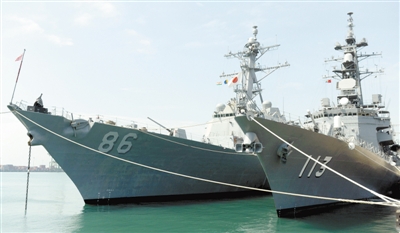
Look at the ship lineup of India, the United States and Japan: the United States sent the Nimitz aircraft carrier with F/A-18 fighters, a Ticonderoga-class guided missile cruiser, an L.A.-class attack submarine, and an aircraft carrier battle group consisting of three to four arleigh burke-class guided missile destroyers. India has sent six to seven frontline warships, a Kilo-class submarine and the aircraft carrier Vikla Matia. Japan sent the "Izumo" helicopter carrier and another warship.

Liu Zhenglu pointed out: "This lineup is quite luxurious. The configuration of the US aircraft carrier battle group is very standard, and cruisers, destroyers and nuclear submarines are readily available. India and Japan are also the best. "

"In addition to the world’s first-class air defense capability, this battle group has a strong ability to search for submarines and anti-submarine warfare, which is mainly reflected in the fact that the Ticonderoga-class guided missile cruiser and the arleigh burke-class guided missile destroyer are equipped with advanced towed sonar, and can also carry out aviation anti-submarine through helicopters. At the same time, the LA-class nuclear submarine itself is anti-submarine warfare’s trump card. At the same time, the specialty of the quasi-carrier Izumo is anti-submarine, because the ship-borne helicopter it carries is the main force of anti-submarine warfare. The Indian navy is also equipped with Ka -28 and Neptune anti-submarine helicopters, and the anti-submarine capability of Kilo-class conventional power submarines is also excellent. Therefore, the anti-submarine capability of the joint exercise of the three countries is still relatively strong. " Liu Zhenglu said.