
On July 10th, a joint maritime military exercise between Japan, the United States and India was launched. Vision china
On July 10th, local time, the "Malabard" military exercise jointly held by India, the United States and Japan officially kicked off near the Bay of Bengal in India.
It is interesting to note that all three countries participating in the exercise have deployed their largest warships for this exercise, with the largest scale in the past years. India sent its only aircraft carrier "Vikla Matia" to participate in the exercise, the United States sent the aircraft carrier "Nimitz" with F/A-18 fighters, and Japan also sent its 20,000-ton helicopter carrier "Izumo". The gathering of three aircraft carriers in the Bay of Bengal is the first time in the history of the "Malabard" joint military exercise.
In this regard, military commentator Liu Zhenglu said in an interview with the Science and Technology Daily reporter: "It is not difficult to see that the scale of the’ Malabard’ military exercise is unprecedented. By conducting such large-scale sea exercises with the United States, Japan and other maritime powers, India can enhance the naval combat capability and strengthen its military superiority in the Indian Ocean. At the same time, it will convey good relations between India and the United States and Japan to the world, and deter India’s strategic opponents from the side to curb the trend of expanding military presence in the Indian Ocean by extraterritorial countries. "
India sent the strongest lineup.
The "Malabard" military exercise is a normal exercise in which India and the United States jointly carry out regional security and defense and strengthen military cooperation in the Indian Ocean. Because the sea area where the exercise was first held was near Malabard, the west coast city of India, it has been called the "Malabard" military exercise for years. The motive of the exercise is to strengthen the common defense at the end of the first island chain in the Indian Ocean, and to strengthen the control and blockade of maritime routes and strategic passages in the Indian Ocean.
According to Liu Zhenglu, from the previous exercises, the main exercises of the "Malabard" joint military exercise are common exercises such as maritime air defense, joint anti-submarine, joint sea control, maritime blockade and maritime communication, and there are also low-intensity exercises such as joint patrol, maritime search and rescue, and temporary inspection and arrest.
This time, India dispatched its only active aircraft carrier, the Vikla Matia. This is the first time that it has conducted a comprehensive combat exercise alone with foreign fleets since its service in November 2013. This aircraft carrier was introduced by India from Russia and modified from the "gorshkov" aircraft carrier. It is now the "trump card" of the Indian navy. Its battle cluster contains the essence of the Indian Navy, and the Kolkata class destroyer, the Sh Oillic class frigate, the Talwar class frigate and the Camol Tower class anti-submarine frigate are all its "imperial guards", while the Kilo class submarine imported from Russia is also the main force of the underwater combat force of the carrier battle group.
"However, the modification of this aircraft carrier is not particularly successful. Its island is too close to the middle of the flight deck, which seriously affects the take-off and landing efficiency of carrier aircraft. Moreover, its power system is not reliable, and seven of the eight boilers failed during the trial. The carrier-based aircraft it carries is the MIG -29K carrier-based aircraft imported from Russia. Although it has been modernized and upgraded, the weight of weapons and equipment that can be carried is low because of the limited space and short range. " Liu Zhenglu said.
He said: "India has sent the strongest team in this military exercise. On the one hand, India is the host country of the’ Malabard’ exercise, and on the other hand, it shows off the strength of the Indian navy to the world and shows its hegemonic position in the Indian Ocean. Of course, the Indian navy has made great progress in armament construction in recent years and has the ability to send advanced ships. "
The purpose of Japan’s participation is not simple.
The reporter learned that the United States and India began to implement the "Malabard" joint military exercise in 1992. In 2007, Japan Maritime Self-Defense Force was invited to participate for the first time, then in 2009 and every year after 2014. In this joint military exercise, Japan sent its largest tonnage helicopter carriers "Izumo" and "Lian" frigates.
Izumo is the latest warship in Japan Maritime Self-Defense Force, with a standard displacement of 19,500 tons and a full displacement of 27,000 tons, which exceeds the Italian navy’s 13,000-ton aircraft carrier garibaldi, the Spanish 17,000-ton aircraft carrier Prince Asturias and the British Royal Navy’s 21,000-ton "invincible" class aircraft carrier.
"Although Japan claims to be a destroyer, it has an island-shaped building, a large flight deck and a large hangar. Its deck can take off and land heavy helicopters, and it can take off and land F-35B fighters after modification, so it is actually a light aircraft carrier." Liu Zhenglu said.
"It should be said that the purpose of Japanese participation in the’ Malabard’ exercise is not simple. The first is the consideration of strengthening cooperation with India. In recent years, for the purpose of jointly fighting against China, Japan and India have many "common languages", and the trend of jointly fighting against China has become more and more obvious. Therefore, strengthening the ties and cooperation between the two armies and countries through military exercises has become an important consideration for Japan. Of course, the joint performance with the US and Indian troops will also enhance Japan Maritime Self-Defense Force’s combat capability. " He pointed out, "On the one hand, the Izumo was dispatched to enhance its combat effectiveness, demonstrate its advanced performance and highlight Japan’s overseas influence by participating in exercises. On the other hand, sending the heaviest warships also shows Japan’s’ sincerity’ in participating in joint military exercises, thereby bringing closer feelings with countries such as India. "
Liu Zhenglu stressed: "In recent years, the Japanese government’s rightwing has become obvious, and it has repeatedly acted on issues such as lifting the ban on self-defense, sending troops overseas, and exporting weapons. By participating in overseas joint exercises, it can highlight the existence of Japan’s overseas self-defense forces and provide assistance for their’ revision of the constitution’."
The participating ships are specially equipped for "submarine search"
The 10-day drill includes submarine familiarization training, air defense, search and anti-submarine warfare. However, the Indian navy admits that anti-submarine warfare is the core content of the whole exercise. Coincidentally, on the eve of the exercise, many Indian media reported that "China submarines entered the Indian Ocean" and "14 China warships were unusually active in the Indian Ocean", hyping up China submarines’ activities in the Indian Ocean. This has to make people guess the pertinence of this so-called routine military exercise.
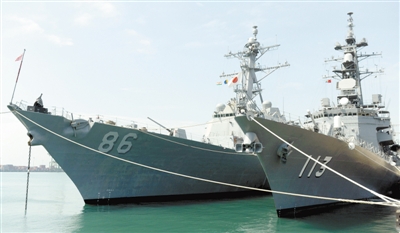
Look at the ship lineup of India, the United States and Japan: the United States sent the Nimitz aircraft carrier with F/A-18 fighters, a Ticonderoga-class guided missile cruiser, an L.A.-class attack submarine, and an aircraft carrier battle group consisting of three to four arleigh burke-class guided missile destroyers. India has sent six to seven frontline warships, a Kilo-class submarine and the aircraft carrier Vikla Matia. Japan sent the "Izumo" helicopter carrier and another warship.
Liu Zhenglu pointed out: "This lineup is quite luxurious. The configuration of the US aircraft carrier battle group is very standard, and cruisers, destroyers and nuclear submarines are readily available. India and Japan are also the best. "
"In addition to the world’s first-class air defense capability, this battle group has a strong ability to search for submarines and anti-submarine warfare, which is mainly reflected in the fact that the Ticonderoga-class guided missile cruiser and the arleigh burke-class guided missile destroyer are equipped with advanced towed sonar, and can also carry out aviation anti-submarine through helicopters. At the same time, the LA-class nuclear submarine itself is anti-submarine warfare’s trump card. At the same time, the specialty of the quasi-carrier Izumo is anti-submarine, because the ship-borne helicopter it carries is the main force of anti-submarine warfare. The Indian navy is also equipped with Ka -28 and Neptune anti-submarine helicopters, and the anti-submarine capability of Kilo-class conventional power submarines is also excellent. Therefore, the anti-submarine capability of the joint exercise of the three countries is still relatively strong. " Liu Zhenglu said.

关于作者