
Today is the 68th birthday of the Republic. On this special day, it is memorable for every Chinese son and daughter to raise the national flag and sing the national anthem. Speaking of the composer of the national anthem, everyone is familiar with it, but the design process and the original designer of the five-star red flag may still be little known.
Shanyin Road, located in Hongkou District, Shanghai, deserves a strong cultural atmosphere. From here, we have walked out of famous writers such as Lu Xun and Mao Dun, as well as cultural celebrities such as Uchiyama Wanzao, Zhao Jiabi and Xie Danru. In fact, in addition to these celebrities, there is also an important figure, that is, National Flag of the People’s Republic of China designer Zeng Liansong. At that time, he sent the first draft of the five-star red flag design pattern from Shanyin Road to Beijing for application, and was finally selected as the national flag pattern.
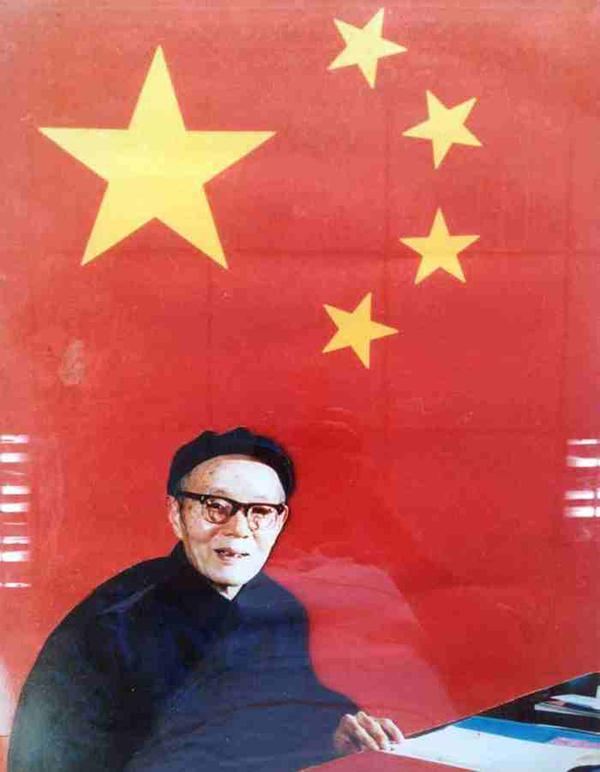
Zeng Liansong took a group photo with the national flag.
Call for papers to participate in the design of five-star red flag pattern
This year marks the centenary of Zeng Liansong’s birth. Zeng Liansong was born in Rui ‘an, Zhejiang Province in 1917. He was admitted to the Economics Department of Central University (now Nanjing University) in 1936. In May 1938, Zeng Liansong was introduced to the Communist Party of China (CPC) by his classmate Huang Daming. In the summer of 1947, Zeng Liansong came to Shanghai and worked as a secretary in the "Modern Economic News Agency" led by the underground party organization. After the liberation of Shanghai, he went to Shanghai Cooperative Supply and Marketing Corporation as the head of research. After the downfall of the Gang of Four, he was reinstated as the deputy manager of his daily groceries company, and later served as a member and standing committee member of the CPPCC.
Zeng Liansong was smart and studious since he was a child. When he was studying in Rui ‘an junior high school, he was influenced by Jin Zuogao, an art teacher and painter, and became interested in painting and calligraphy. When studying at Central University, Zeng Liansong often attended Professor Zong Baihua’s aesthetic theory class, which laid the foundation for his later design of five-star red star patterns.
It was July, 1949, and the golden morning light was all over Shigaota Road (now Shanyin Road) in Hongkou, Shanghai. In the newspaper that had just taken to the street, a call for papers attracted the young Zeng Liansong: the preparatory group of the first China People’s Political Consultative Conference publicly solicited the design scheme of the new China national flag.
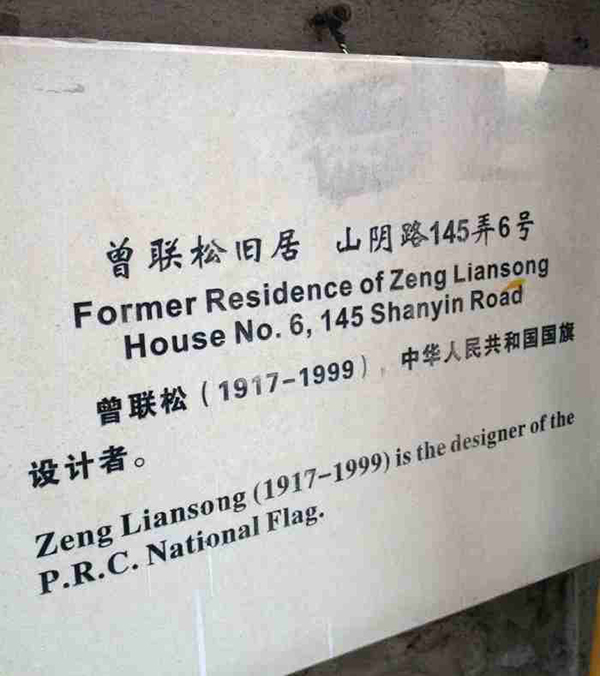
The brand before Zeng Liansong’s former residence.
After a long night, the sun rises. Zeng Liansong, who joined the Party as a student and worked in finance for many years, came up with an idea: I want to design a beautiful national flag for the new China.
It is hard to imagine what kind of enthusiasm and motivation pushed Zeng Liansong, who has been dealing with abacus and figures all day, to pick up brushes and scissors to do this "national event" that seems to be the concern of artists.
Perhaps, as Zeng Liansong himself said, "The reason why we don’t do our best and don’t care about our work is really a joy of cheering the birth of new China and a passion for patriotism."
Countless sleepless nights, when Zeng Liansong fell asleep with the early morning light, his wife could sweep out countless waste manuscripts and cut colored paper from the humble room.
Inspiration always comes late but unexpectedly. On a moonlit night, looking up at the starry night sky, Zeng Liansong suddenly seemed to realize that people often say "look forward to the stars, look forward to the moon". Isn’t the Communist Party of China (CPC) the great savior of the whole country?
Another morning, when the outline of the five-star red flag appeared on the desk, Zeng Liansong’s face smiled-this is the new China flag in his mind. However, more than a month later, when Zeng Liansong saw the national flag pattern adopted by the first plenary session of Chinese People’s Political Consultative Conference in the newspaper, he still couldn’t believe his eyes-isn’t this the five-star red flag designed by himself?
Officially became the national flag.
According to the data, after the announcement of collecting the national flag, the national emblem pattern and the lyrics of the national anthem, the recruitment papers from all over the country and overseas Chinese flew to Beijing, with a total of 3012, which shows the enthusiasm of the people and overseas Chinese at that time.
At that time, the selection of the national flag pattern (including the national emblem and the national anthem) was handled by the Sixth Group of the Chinese People’s Political Consultative Conference Preparatory Committee, which was composed of Ma Xulun as the team leader, Ye Jianying and Shen Yanbing as the deputy team leaders, Zhang Xiruo, Tian Han, Ma Yinchu, Zheng Zhenduo, Guo Moruo, Li Lisan and Jian Bozan. Later, celebrities such as Xu Beihong, Liang Sicheng and Ai Qing also participated in the selection.
In August, 1949, the Preparatory Committee of the Chinese People’s Political Consultative Conference set up a temporary reading room for the national flag pattern in Beijing Hotel, where the collected design patterns were displayed in a centralized way, and members of the selection committee and experts were invited to read and comment. According to the characteristics of China, political power and solemn and concise requirements, we reviewed the patterns one by one. After careful discussion, many members and experts think that Zeng Liansong’s design is "beautiful and generous, with good meaning", but the fly in the ointment is that the sickle and hammer designed in the five-pointed star can easily make people feel like imitating the Soviet flag. Everyone thinks that it is better to delete it and highlight the characteristics of China. Members of the selection committee and experts selected 38 sketches and compiled the Reference Materials of National Flag Patterns for discussion and decision at the first meeting of China People’s Political Consultative Conference.
1949年9月23日,政协第一次会议举行分组讨论时,委员们对38幅国旗草图进行了审阅,大家各抒已见,对曾联松设计的图案和另一张标有黄河的图案评价较高,但没有最后决定。
两天后,毛泽东主席邀请了文化艺术界45名知名的政协委员,对国旗、国歌、国徽等草图草案进行协商。座谈会上,大家比较一致地倾向于曾联松设计的五星红旗图案。毛泽东表示,可以把说明改一下,不说四颗小星代表四个阶级,要说五星红旗代表全国革命人民大团结,现在要大团结,将来也要大团结。
9月27日,中国人民政治协商会议第一届全体会议通过《关于中华人民共和国国都、纪年、国歌、国旗的决议》中规定:“中华人民共和国国旗为五星红旗,象征中国革命人民大团结。”这样,曾联松设计的五星红旗图案就正式成为了国旗。
1949年10月1日,北京天安门广场举行隆重开国大典,毛泽东主席在天安门城楼上,亲手揿动电钮,升起了新中国第一面五星红旗,全场30万群众一片欢腾。
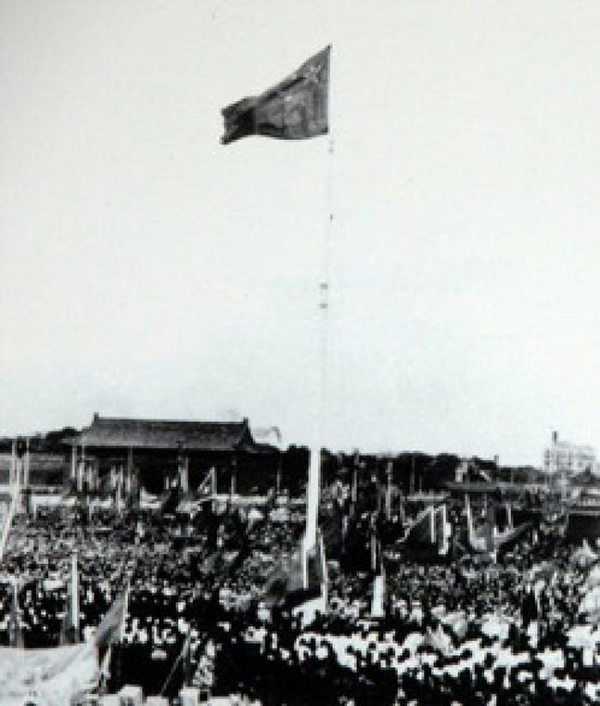
开国大典上的升旗仪式。
受邀参加国庆观礼
曾联松从1947年起就居住在虹口区的山阴路上,直到1999年10月19日逝世。1950年新中国成立一周年时,曾联松受邀赴京参加国庆观礼。他站在天安门城楼上,心情十分激动。观礼结束后,曾联松赋诗《赴京观礼》一首:“乘风秋日走燕台,香拥红旗桂蕊开;叨陪盛典粹英才,铠甲山河入画来……”表达了此时他的喜悦心情。同年11月,曾联松收到了中央人民政府办公厅的一封信,信中说:“曾联松先生:你所设计的中华人民共和国国旗,业已采用。兹赠送人民政协纪念刊一册,人民币500万元(折合现人民币500元),分别交邮局及人民银行寄上,作为酬谢你对国家的贡献,并致深切的敬意。”
1979年10月1日,建国30周年时,曾联松再次受邀赴京参加国庆活动。1987年曾联松离休后,虽然有享受局级待遇,但他没有闲着,经常去部队和学校,为广大战士和青少年学生讲述自己的爱国经历,进行爱国主义和革命传统教育,激励人们更好地传承革命传统,建设好国家。
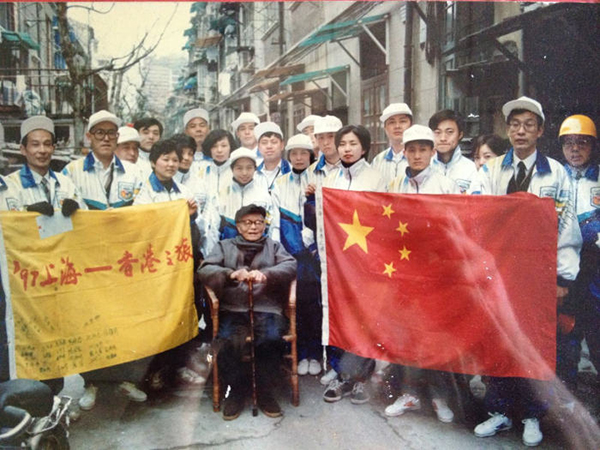
In 1997, Zeng Liansong took a group photo with the Hong Kong delegation visiting Shanghai.
"Mr. Zeng is very low-key. He usually goes in and out of the alley, always wearing a Chinese tunic suit with a leather bag. Few people in the alley know that he is the designer of our national flag pattern. When I was in the fifth grade of primary school, when the teacher was telling the text, I discovered that Mr. Zeng was the designer of the national flag pattern. "Shen Meili, a neighbor who took care of Zeng Liansong in his later years, said that Zeng Liansong rarely went out because of illness in his later years. He always wrote things on cigarette paper with a brush, and he helped him buy them according to Mr. Zeng’s needs.
On June 30, 1997, the day before the return of Hong Kong, Zeng Liansong presented a national flag with his name to his neighbor Shen Meili. This precious national flag has been carefully wrapped in cloth for 20 years.
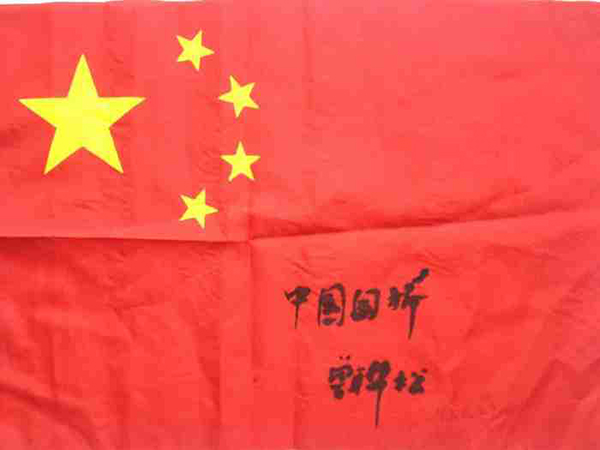
Zeng Liansong signed the national flag for his neighbor.
Today, 68 years later, the five-star red flag is flying high in every corner of 9.6 million square kilometers of land, and it has entered the sea with the "Tiangong" and "Xiaolong", accompanied by Olympic athletes to triumph, and has become a common symbol of the People’s Republic of China, 56 ethnic groups and 1.3 billion Chinese children. (Original title: Five-Star Red Flag Design Draft, sent to Beijing from here)

关于作者